Thursday, 19 January 2012

queries of a tea-drinker profiler

Why blog about tea? Why indeed?

I could easily drink tea and share it with my friends. When travelling, I could visit tea shops/tea rooms and write about them on a travel blog or just keep it to myself. 

Several years ago, I was talking to a friend about social media and blogging. The prevailing wisdom that we were talking about was: blog about your passion. Although I studied music and literature and am quite passionate about both, I couldn't fathom having a blog about one or the other. Or not exclusively about either. 

What was I knowledgeable about? What sort of thing did I feel I had to offer? For a long time I kept telling myself, 'As much as tea intrigues you, you simply don't know enough about it to be a successful teablogger.' I'd read others' work on tea and look at their beautiful photos, and thought I simply didn't have the expertise necessary to add anything. But then my friend made an off-hand remark that in a moment changed everything. 

She said, 'You could make your discovery of tea the focus of the blog. You know, to document learning about tea.' That was the angle I needed. That was my focus. Early on, that and my enjoyment for the tea I'd been drinking was what propelled me. The longer I've done it, the more I settled on my own personal voice. 

When I travel, I search out tea-related things and blog about them. In my daily life, I introduce friends and clients to tea. I joke about luring people over to the leaf-side, but the times I've done so have been truly joyful. Either people who already drank tea but didn't have experience with loose-leaf tea, or even people who had never considered drinking the beverage.

In the process of doing this, I often think of the Lasse Hallström film Chocolat. In it Juliet Binoche's character Vianne Rocher looks at a person and divines what sort of chocolate they'd most like. I have no illusions that I'd be able to do anything of the sort when it comes to pinpointing the perfect tea for a person.

Here's the trailer for the film (you can see Judi Dench go into a moment of revelry around :43-48):


However, I've toyed with the idea for years that I could ask someone a few questions about his or her food/drink preferences and then be able to predict what sort of tea they'd like. I've written about it on this blog a bit, as well as discussed it with tea drinkers in a variety of forums.

Here are some of the questions I like to ask:

How do you take your coffee? little milk/cream or a lot? Sugar/honey? Or black?
Do you like spicy foods? If so, what sort do you like most?
Any vegetables/spices you really adore? That you crave? Or the opposite: any that you loathe? That you avoid?

Isn't that an interesting topic? Can you think of any other questions that might illustrate any more taste preferences?

As my friend Cevie has said, I'm trying to be a profiler of a kind. Not a serial killer profiler, but a tea-drinker profiler. That doesn't sound so bad. I can live with that.


Sunday, 15 January 2012

fasting tea - herbs that clean you from within


the green balloon is a symbol - what'll happen to the green ballon?

Let me start out with two very weighty disclaimers. I'm writing about products that market themselves as tea, but have absolutely nothing to do with the Camellia sinensis plant. They call it 'fasting tea' and although I'm aware that plenty of you will take issue with the terminology, I'm just not prepared to go through the entire post and keep writing 'fasting tisane'.

The other thing is that I have no personal experience with any of these products. I don't drink tea to enhance my fasting. You'd immediately be able to tell from my less-than-svelte appearance that I haven't fasted in years (if ever).

Why am I writing about it then? I saw something about fasting tea in a complimentary magazine called Schrott&Korn, which you find in many health food stores in Germany. Typically when I see something tea-related in my daily life, I make some sort of attempt to incorporate it here. Before I go on about it, here's the original article:


Here's another disclaimer. 'Jeez, there are a lot of those so early into this,' you say? Actually, I think this is important enough to make quite a bit of it. The health benefits that are claimed tea drinking will bring you are often laughable and sometimes even downright deceptive. So much so, that I spend half of any post I write on this subject stating and restating that I'm neither a medical doctor nor scientifically versed enough to verify any of the things upon which I'm reporting. You've been warned.

The first point the article makes is that the fasting tea is only going to be as good as its ingredients, which is nearly too obvious for me to repeat. Yet the point that's made is that when you're fasting, your body is particularly vulnerable to products that might've either been grown with pesticides or handled in some other improper way. Apparently, the herbs shouldn't be fumigated or irradiated either. 

As a rule Germans take this sort of thing rather seriously. Not sure wherever you are in the world that you'd even know if they'd been doing these things to products, but here...here, this sort of thing is checked quite carefully.

What's the result of herbs in tea?

According to the article if you're intention is to purify and detoxify your system, then it's your liver, gall bladder and kidneys that need the most attention. What ingredients do the most for those organs? The usual suspects that are in many fasting teas are: stinging nettle, birch leaves, and juniper berries

Now, remember: Am I a doctor? No. Am I recommending that you go stock up on stinging nettle, birch leaves, and juniper berries? I most certainly am not. Just telling you what I've read.

Dandelion is a diuretic and Milk Thistle is helpful in liver regeneration (it's the Flavonol Silymarin that does it, but I assure you there'll be no test). Who didn't know all that? (I didn't)

Elder berries take away the inflammation and decreases sweating, while (pepper)mint will calm your upset stomach and make your digestion more regular (actually, I knew that last one).

In the rhythm of a day; typical fasting herbs

From my understanding, you should be avoiding coffee or true tea (you know, anything coming from the above-mentioned Camellia sinensis plant) if you're doing a proper fast. For some reason, that's why so many fasting teas have Mate in them.

There's both caffeine and Theobromine in the Mate, and I'm only just now realising that Mate needs it's own post. There are plenty of people out there in the tea world talking about Mate, and I'm sure none of you can forget Lisa Galaviz's trip to Teavana in How NOT to go to a Tea Shop, where she came back with Mate and I insisted you Don't tell her it's not tea.

But the real point of this whole post was to come round to talking about stinging nettle

If you didn't bother clicking over to that Wikipedia link, there's a very humourous bit about Competitive Eating in which they describe:
In the UK, an annual Stinging Nettle Eating Championship draws thousands of people to Dorset, where competitors attempt to eat as much of the raw plant as possible. Competitors are given 60 cm (20 in) stalks of the plant, from which they strip the leaves and eat them. Whoever strips and eats the most stinging nettle leaves in a fixed time is the winner. The competition dates back to 1986, when two neighbouring farmers attempted to settle a dispute about which had the worst infestation of nettles.


Doesn't that sound like a lot of fun?

So stinging nettle is a very curious plant to me. Again, thanks to Wikipedia I know that it's a dioecious herbaceous perennial. Really? A perennial? How lovely. 

There're few things I'd rather avoid when I'm out in nature in the summer than stinging nettle, but I've often heard that it's not just nutritious when cooked, but used in many alternative health remedies. Specifically in a fasting tea'Oh, are we back to that?' you ask. 

Well, yes. That was the original point of all this, wasn't it? 

The article itself made quite a bit of noise about a brand of fasting tea that you probably can't even find anyway, unless you're in Germany. Purportedly, the five different sorts they offer are created for either the specific time of day or a unique aspect of fasting. To my eyes, it looks like clever marketing, but I'm not going to advertise the brand here. You can go to the link if you're really curious.

Would I recommend you use either this or any other product to aid whatever fast you might endeavour to take part in? I would NOT. I'm only passing on the information as I found it. 

Do I think you should have a Competitive Eating contest in which you consume stinging nettle? Now that is something I can stand behind whole-heartedly. 

remember the green balloon? that's all the bad stuff you get rid of when fasting


Tuesday, 10 January 2012

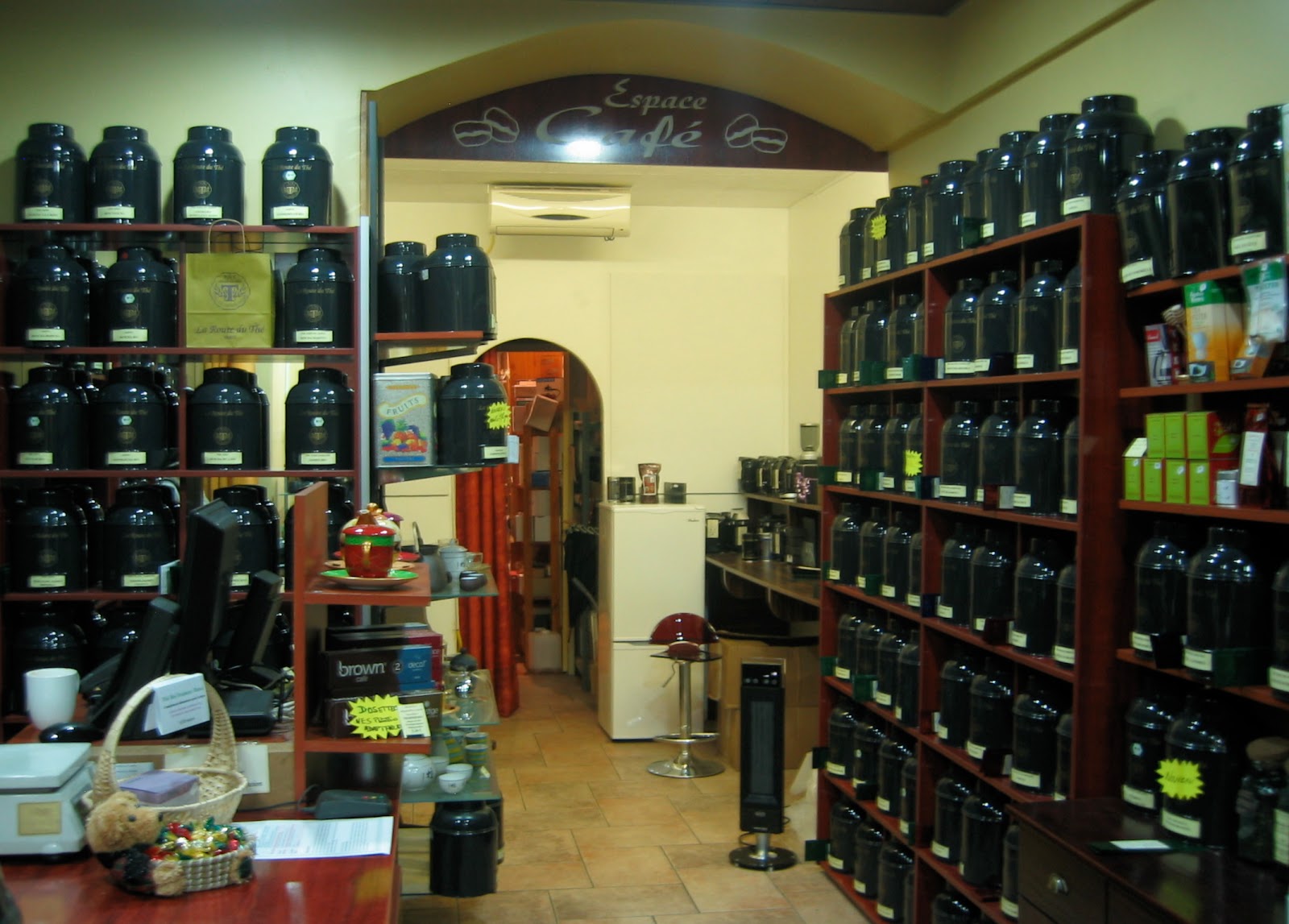
Nice's La Route du Thé

outside looking in
The other day, I mentioned that I was particularly thrilled about a tea shop I found in Nice. Decided that including La Route du Thé in a post with the others was not giving it the attention it deserved. I'll actually go back and link to this post in the earlier one just to make sure no-one overlooks this place. That's how convinced I am.


A tea shop is a tea shop, right? They're all offer pretty much the same thing. Why make such a fuss about this one or that one? Well, once you've seen enough different establishments, there are some that just stand out. Sure the quality of the tea and tea ware they offer is paramount, but there's something intangible that draws you to certain places. 


This place has that intangible thing for me. If I lived in Nice, this would definitely become one of my regular haunts.


plenty of selection
For one thing, the tea seller himself (Alain Bantwell) is clearly passionate about tea in general. But when he talked about his tea, his eyes lit up. You'd expect that always, wouldn't you? And let's face it: if you've dedicated yourself to having your own tea shop, you're most likely quite convinced about tea. Once again, this guy had that and more. 


He spoke enough English and I spoke enough French that we were able to get our basic thoughts across to one another, but when he started showing off his tea...well, did I mention the 'eyes lighting up' thing? Pretty sure I did. 


Then, he let his lovely assistant, who spoke English quite well (and insisted that I not include her name) tell me about the shop. She spoke highly of a Salon du Thé in the beautiful Cimiez neighbourhood of Nice called L'Altro Cose Cosi. I really must check that out next time I'm in town.


But back to the tea shop. That's what you're here for, right? 


tea ware and gift packages


I'd not heard of the brand of tea La Route du Thé, but it's a relatively small company with five shops in Paris. You know I'm going to visit at least one of those when I'm next in the French capital. 


This is the only shop carrying their tea outside of Paris. Although he'd left me in very capable hands, Mr Bantwell came rushing out from the back of the shop because he clearly wanted to tell me something else that was important. 


It seems that all of the flavoured tea is made with all natural ingredients. He insisted that as a small company, they refused to use chemicals in any of their flavourings. Again, that this was important to him-that he made such a point of it, made me appreciate this shop all the more. He also knew I was based in Germany, where artificial flavourings are frowned upon. Most certainly.


I asked him about his selection of Darjeelings, and he showed me a Darjeeling Puttabong whose leaves were so fragrant that I almost fainted. When I enquired what reliable tea was that he'd 'go to' nearly everyday, he opened a canister of golden-tipped Yunnan 'Celeste' that almost made me want to swear off any other Yunnan. Almost, but not quite.


lovely teapot with a box of the house tea brand
Oh, before I forget about those flavoured teas: he showed off some Réglisse Thé (licorice tea) that almost made me forget I'm not very keen on flavoured tea. The Amandes Thé (almond tea) also smelled divine, as did the several sorts of Earl Grey that he had. Not my sort of thing, but the leaves and Bergamot oil were very fragrant.


If you're in Nice, or anywhere nearby for that matter, I'd highly recommend taking a look at La Route du Thé (9 bis rue de Rivoli 06000 Nice Tel : 04 93 16 94 33). You'll be glad you did. 

Saturday, 7 January 2012

a bit of Nice tea shopping

So a year ago, I wrote A few Nice places for tea and that piece dealt with places to drink tea in Nice, France. Try as I might've this time around, I don't have much to add in that regard. And the few new places I do have to recommend each deserve their own individual blogposts. 


But let's say you do roll into Nice (or fly in, whichever the case may be) and you realise you didn't pack enough loose-leaf tea at the beginning of your trip. Are you really going to be forced to go to Galeries Lafayette and buy a box of tea leaves from a major French tea brand? Well, you certainly can do that. Am not entirely sure how long the tea's been sitting on the shelves, but it'll certainly do in a pinch.


a wall of Mariage Frères 

Kusmi Tea and Dammann Frères
They have Mariage Frères, which is quite good. Then there's Dammann Frères, which I don't know well, but I see there boxes all over. Finally, there's also Kusmi Tea


Xavier's done some research on Kusmi, and here's his post on a radio interview that he transcribed and translated (An interview with Kusmi).Their tea (that I've seen) is flavoured and a tad pricey , so I've not taken the plunge and tried them. Nevertheless, I've heard good things about this company, and I'm sure one day I'll give it a go (Xavier assured me that they have unflavoured tea. I've not actually seen it).


The next place you might try is Bjeteman & Barton (11, rue Maréchal Joffre 06000 Nice +33 1 (0)4 93 92 70 22), which is apparently a high-end Parisian tea brand. Their shop in Nice is centrally-located and they have quite a good selection of both loose-leaf and bagged tea, as well as plenty of attractive tea gear. It's not an Asian specialty shop, but for nice Wester-style teapots, cups and saucers, this is definitely an excellent destination. Again, this is an upscale establishment. I certainly didn't say you'd be able to leave without lessening the weight of your wallet.


Here's a photo of their front window:


Bjeteman & Barton


The place I was most impressed with last year and even more so now that I've gotten my hands on a copy of the book The Tea Drinker's Handbook, which was written by Francois-Xavier Delmas the founder of Le Palais des Thés (3, rue de la Liberté 06000 Nice +33 4 93 81 56 16). Beautiful book (also written by Mathias Minet and Christine Barbasteand beautiful shop. 
This place knows what they're doing. I'd say this was the French answer to Teavana, but it's likely the other way around. I suppose that the American chain could've modelled itself on this French one rather than vice versa. 


Here's a photo of their storefront:

Le Palais des Thés
tea ware at Le Thé
Around the corner and several hundred metres away in rue Pastorelli is yet another tea shop. This one's called Le Thé (39 Rue Pastorelli 06300 Nice +33 04 93 80 45 79), which is clearly more Eastern in appearance. They have an impressive selection of tea from around the world, but the tea ware (exquisite clay teacups and teapots) is clearly of the Asian variety.


Xavier noticed something before I did: many of the distinctive flavoured tea from Le Palais des Thés were identical here at Le Thé. To be clear, it's most definitely not a franchise. Le Thé is selling tea under their own name, but the exact same names indicate the same source for their more auspicious blends.

To be candid, the few teas that we compared at both locations were a tad more economically priced at Le Thé, but it definitely wasn't substantial. Not sure it's worth going out of your way for the minuscule difference, but it is worth noting.

you can find the shop easily under the bright green sign
And now I have a bit of a cliffhanger for you gentle readers. The whole time I've been here, I've walked by one last  teashop, but always at the wrong hour. The shop is open often enough. It's just that I was there too early or too late. Even today on my last day, I arrived right in the middle of their midday break. Here's the thing, though. I was so impressed with La Route du The that I've resolved to write an individual blogpost for this shop. It was that extraordinary. 


So, even though I've given you a rather thorough review of some of the teashops in Nice, you'll have to wait just a bit longer for my review of the one I enjoyed the most. You can barely contain your anticipation, can you? I know you all pretty well. 

Tuesday, 3 January 2012

searching for tea in choclate-y places


deceptively tea-related 

Last year when I was in Nice, I wrote a post called A few Nice places for tea, where I mentioned some of the possibilities for drinking tea here in the South of France. Earlier today, I walked by the Café Indien that I wrote about then and it appears business is still thriving. There are actually a few new tea shops as well as a Salon de thé or two that I've seen and I plan to talk about some of them in the coming days. You can hardly wait, right?

Today was the first day that some tea shops finally reopened after the Sylvestre (New Year's) holiday, and Xavier and I were on a mission to find good tea-related things to report on. I'd circled the block looking for a place a year ago, and I was persistent in my desire to locate it this time around. With Xavier's help, we got much closer. But it still eluded us, and I'm hoping it's a more enthralling story than that the place simply went out of business. 

Then we scouted out a few more places, but either they weren't open till afternoon or they were obviously inappropriate. Here's the thing: just because a place is called a Salon de thé in France, that doesn't necessarily mean that it has anything to do with decent tea. It might, but it's definitely not guaranteed. 

From what I can tell, Salon de thé only means 'an indoor place to sit and have something to drink and possibly eat'. Not that there's anything wrong with that, but I wish they wouldn't include tea in the name. It's not only confusing-it's also a bit disconcerting.

A place I avoided the first time I scouted out good locations was Seizième De Soupir, which to my eyes looked like the sort of place a socialite might go to take a break in the midst of her shopping. But we were starting to get desperate as the other places on the list seemed less and less suitable. Or less and less open.

So here we were:

Looks more like a chocolate shop than anything tea-related, doesn't it? Well, there was definitely some other-worldly looking chocolate creations, and when I become a chocolate blogger, I'll definitely be returning to this place.

But I can assure you...this was quite a good find to get a cup of tea, as well. You want to read more on that, don't you? This is a teablog, after all.


The tea on offer was from a company called Mighty Leaf Monte-Carlo, and I have no idea if they're connected to the Mighty Leaf Tea in the United States. Will try to find that out. The choices were: a 'Himalayan Peak' Darjeeling, an Earl Grey, a very good Hojicha, something called 'Green Tea Passion' (something to do with green tea and tropical fruit), another green tea called 'Jasmine Mist', as well as a 'Marrakesh Green Tea' (gunpowder mixed with peppermint), and finally a very radical thing called 'Coco Chai' (Rooibus with coconut, red pepper and other spices). 

What would you guess we went for? Well, we both wanted to try the Hojicha. And a good portion of our afternoon was spent talking about this tea in particular and Hojicha in general. To anyone but a tea obsessive, that sounds like a dull afternoon. For us, it was anything but boring.

Again with my translation of the French (aided massively by Xavier): 

'This green tea is quite popular in Japan. It's rather tasty due to the manner in which it is roasted. Woody with an aftertaste of hazelnut.'
Here's how the leaves looked (I thought they looked more like a highly-oxidised Oolong than a typical green tea):

The first infusion tasted nothing like a green tea, which is a common reaction to Hojicha. Only in the second infusion were we able to detect the hazelnut aftertaste.

But the whole experience? The tea, the location, the beautiful sunny day in the South of France. Would we recommend it? We definitely would. Right Xavier?


Here's how it looked under the chandelier:


Monday, 2 January 2012

add tea preparation to her feminine wiles

she can make me tea anytime she likes


Xavier showed up the other day with a book in tow. He asked, 'How good is your French?' and in retrospect, I suppose it's not as good as the impression I gave him it was. Although I understood most of what I was reading, my translation is questionable enough that I had to double check it with him.


The book is Le thé dans l'encrier, which is nicely displayed here: Grillon du foyer. And immediately I was drawn to an essay about Honoré de Balzac and the seduction of tea. It talks specifically about one of his later books La Cousine Bette and what sort of tea drinker Balzac was in reality. 


The essay starts with a Chinese proverb which has been translated from the original Chinese to French to German and finally to English, but here it is:


'You can forgive a murder, but never a mistake while preparing tea.'


And the author (Gilles Brochard) discusses two sorts of people when it comes to tea drinking. Again with my pigeon translation: 


'I want to give them the opportunity to express themselves. We shouldn't confuse those who can or will be entirely seduced by tea for the entirety of their life and then those who alternate between both coffee and tea. I believe that Balzac was in the second category.'


This is a curious topic on which I find tea drinkers go back and forth. Some of us are even a bit hesitant admit that they even drink coffee. Some tea drinkers have never had coffee or when they have they simply didn't enjoy it.


Why is this even a topic, right? If you like drinking both coffee and tea, why should you have to somehow hide it? Not with me you don't. There's been some enjoyable joking in my circle of acquaintances about how drinkers of the bean and the those drinking of the leaf can live in some sort of harmony. From my perspective, I certainly cannot see why we can't.


Even more interesting was the Cousine Bette translation that I found online. I've gone on at length about how men shouldn't feel ashamed drinking tea in masculine tea drinkingThe masculinity of drinking tea continues to attract not only the most readers but also the most comments on this and other teablogs. Even with the assumptions and stereotypes of women and tea drinking, I was intrigued by how Balzac handled the topic.

'Just then, Valérie herself brought Steinbock a cup of tea. This was more than a mark of attention; it was a special favour. There is a whole language in the way a woman performs that office, and women are well aware of this. And so it is interesting to study their movements, their gestures, their looks, and the pitch and intonation of their voices, when they perform this apparently simple act of courtesy.      
From the question, 'Do you drink tea?' 'Would you like some tea?' 'A cup of tea?' asked coldly, and the order to the nymph presiding over the tea-urn to bring it, to the eloquent poem of the odalisque coming from the tea-table, cup in hand, and offering it submissively to her heart's pasha, in a caressing voice and with a look full of voluptuous promise...'
(source & more about Cousine Bette at Google Livres)


Not only that she asks 'Do you drink tea?', but it's the manner in which she asks it. She may add tea preparation to her list of feminine wiles. I looked up the definition of wiles to make certain that it doesn't always have a negative/sinister connotation. It doesn't. Well, it doesn't necessarily have to.


Is the entire question of the femininity of tea drinking or tea serving completely outdated? Am I going to get a lot of feminist blowback for even asking if a discussion can be made of this?


If we were talking about the book itself, the theme of tea drinking would hardly come up in discussing Cousine Bette. It's a bit of a stretch for me to even write an entire blogpost about it. This text is a blend of a morality tale full of vice and salaciousness and a study of mid-19th century Paris society and culture.


Having already excused myself for stretching this into a theme, is there such a thing as feminine tea drinking? Is it even worth mentioning?


(update: here's something that @elaine4queen sent me as a response to this post: Catherine of Braganza. I'm pretty sure I saw something on either Leafbox Tea or Tea Trade about her a while back, but it's good to be reminded of this again.)