Showing posts with label Matcha. Show all posts

Monday, 12 March 2012

Searching for Tea in Berlin

holding my breath till I find good tea
Not sure how to break this to you, but I'll pull the proverbial band-aid away: I found a really nice tea shop/tearoom in Berlin. If you've been following my travels, you know that my prospects were not looking good. My last post was written as politely as I could manage, but I doubt I'd recommend anyone go there. Perhaps only if you were to buy tea and take it home with you.

Tee Tea Thé in the early evening
I should say that I did find Tee Tea Thé (Goltzstraße 2, 10781 Berlin 030/21752240) in Berlin-Schöneberg the first evening I arrived. They sell a variety of tea brands including Ronnefeldt and Pure Tea, even Celestial Seasonings, as well as a handful of others.

the shelves at Tee Tea Thé


When I stayed in a nice hotel in Stuttgart, I thought a bit about Ronnefeldt Tee when I wrote In defence of a brand of teabags. Up until then, I'd only had the tea-bagged version, but here was row after row of this loose-leaf tea on offer.


Most German tea companies that've been around for more than a century are located in harbour cities such as Hamburg or Bremen. The fact that Ronnefeldt was founded in 1823 in Frankfurt am Main (far away from the coast) is both curious and impressive to me, and this brand appears to be the tea that many good hotels worldwide choose to serve. I've asked it before: How did that come about?

I'd certainly like to get to know this tea brand even better. Frankfurt's not so far away. Maybe the next time I'm there, I'll arrange to visit Ronnefeldt's headquarters.


Was even more curious about Pure Tea. This was also a brand I'd heard of, but not yet tried. I like the concept of all pure, unadulturated tea, so I got a package of their White Downy Oolong Longkou. I brewed it as Gong Fu as I could in a conventional glass pot, but I can't wait to get home and try it in my Gaiwan. Huge light brown and green leaves with plenty of white tips, this Oolong has a both vegetal notes, as well as a taste of honey.


Tee Tea Thé isn't only a tea shop, though. It's a proper tearoom, as well. Plenty of reading material strewn about and people either chatting or studying diligently. If I lived near here, I could see this place becoming my second living room.

Teehandelshaus Benjowski


If rare tea is your thing, you really should consider going to the northern side of Berlin. It's a bit odd for me to recommend Teehandelshaus Benjowski (Danziger Straße 3, 10435 Berlin 030/4403 ext. 7571), since when I went to visit the shop, they'd already closed for the weekend.


Nevertheless, I'd heard so many good things. If one can tell anything from peering in the window right after closing time, I can assure you that they have an astonishing collection of Yixing teapots. Everyone I talked to about this shop said the selection of tea was similarly impressive. 


Berliner Teesalon


But the experience that saved my tea search in the German capital was the Berliner Teesalon (Invalidenstraße 160, 10115 Berlin 030/2804 ext. 0660). The people running this shop clearly know what they're doing. It's not only a tea shop with quite an unbelievable selection of loose-leaf tea, but there are tables and plush chairs where you can sit  and really savour your time drinking tea. It's an incredibly inviting atmosphere, and had I not shown up there half an hour before closing time, I'm positive I could've sat there the better part of an afternoon. 


There's all of the typical tea you'd expect: a few nice Keemuns, quite a selection of both Chinese and Japanese green tea. Yunnans, Darjeelings, Ceylons and Assams...I could go on, but instead I'll link to their website here, and you can go look for yourself. It's quite a list.

the salon of Berliner Teesalon
It was when I started chatting with the young woman running the shop that I found out about the good stuff. I'm often looking for a good way to get deeper into Pu-erh, so imagine my delight when I happened upon their Pu-erh cabinet. Gorgeous stuff in there. 

the bar at Berliner Teesalon

Partially because I wouldn't shut up about my Taiwanese Oolong obsession, she also showed me some Lagertee (stored tea) that I desperately wanted to try. There was also talk of Oolongs grown in Thailand - this is something I'd like to learn more about. I've certainly heard/read about Thai Oolongs, but not yet tried any. 


tea gear at the Berliner Teesalon
Looking back at what I've written so far, I don't think I've done justice to Berliner Teesalon's Japanese green tea selection. It was notably extensive. There's also plenty of tea gear if you want to get into Matcha. That in addition to Yixing teapots, as well as more conventional Western teapots and tea cups. If I had a tea shop/tearoom, I hope I'd have such a nice selection. I couldn't recommend this place more highly.


Finally, after quite a bit of walking over the several days I was in Berlin, I saved the Tadschikische Teehaus  ‎for last (Am Festungsgraben 1, 10117 Berlin 030/2041112). It's centrally located, but you'd never know it was there unless you were looking for it. You can find it inside the Palais am Festungsgraben right off of Unter den Linden  - just a few hundred metres from the Museum Insel.
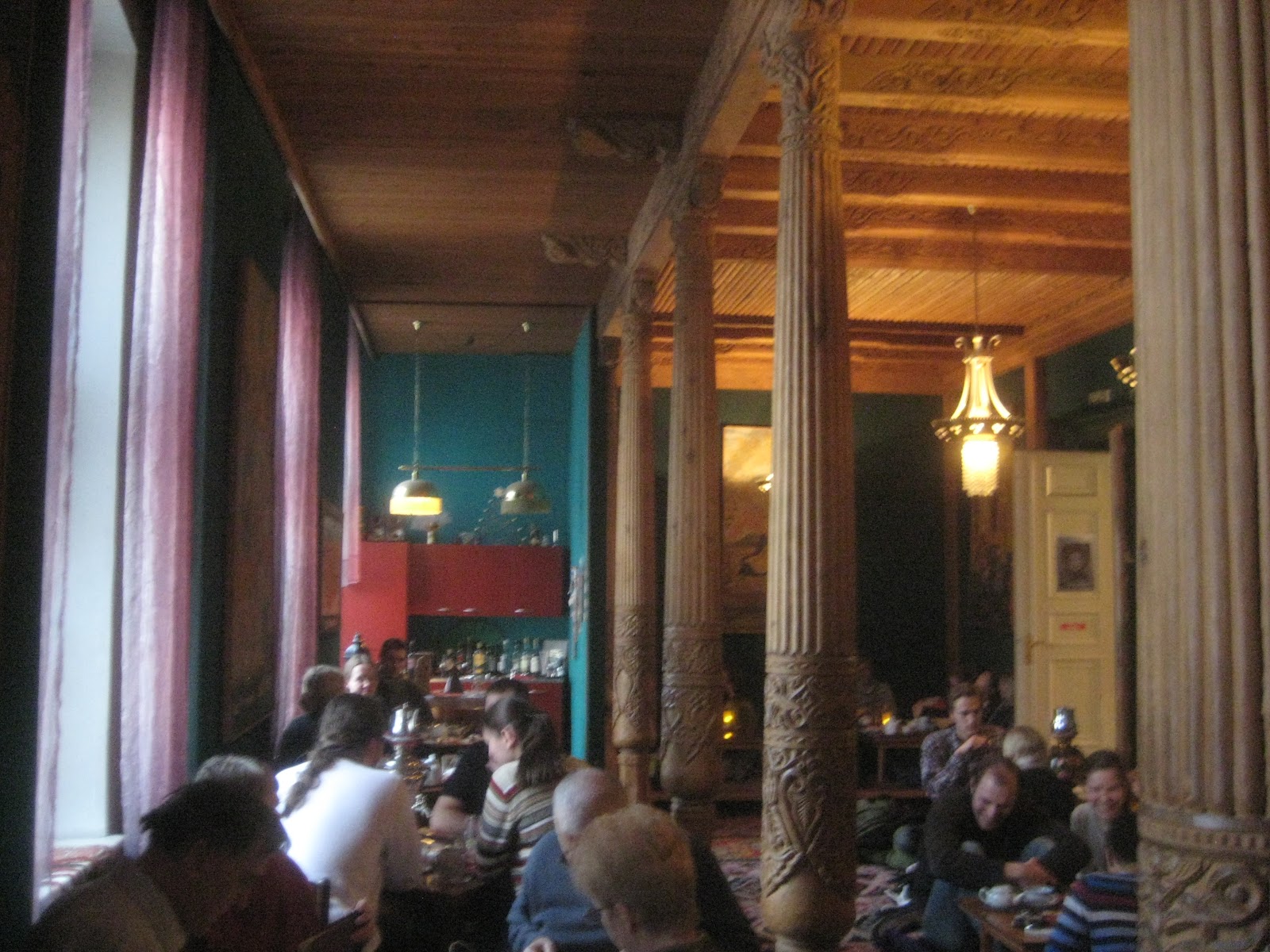
in the Tadschikische Teehaus
Until you go up the staircase and locate the room outside the tearoom where everyone's taken off and left their shoes - until then, you can't actually believe there's a place here to drink tea. But there really is. Please persevere in your search. Finding the Tadschikische Teehaus a nice reward. No idea how authentic it is, but to me it looks like what a tea house in Tajikistan might.

sipping at the samovar

Although they have several tables, be prepared to sit on pillows on the floor. The tea is not only served in an assortment of funky teapots,  I had the Lommonossow-Tee (something purportedly from the 'eastern banks of the Black Sea'), but you can also order what's called a Russian Teezeremonie (tea ceremony), which appear to be not only tea served in a samovar, but a selection of delicious things to munch on. Actually, there was a full menu that I didn't even glance at, but I'm sure I would check it out if I were in Berlin more often.


ahhh...hot, delicious tea

Saturday, 13 August 2011

tippling at the Japanese Teahouse


Finally did something today which I'd been planning for months. See, the Japanese Teahouse in the Englischer Garten in the heart of Munich has very limited opening hours. It's not a teashop actually, so I guess it's not so odd. Nevertheless, they're only open on the second weekend of each month (and I'm doubtful that they open through the winter).

I kept intending to go, and then promptly forgetting that it was the second weekend of the month till Monday morning. Too late. So each time this happened, I had to wait roughly another four weeks.

Before I go into my impressions, here's what Wikipedia has to say about it in the middle of their article about the Englischer Garten:

Japanese teahouse/Japanisches Teehaus KanShoAn

In April 1972, to celebrate the Summer Olympics of that year, which were held in Munich, a Japanese teahouse and a Japanese garden were created on a small island at the south end of the Englischer Garten, behind the Haus der Kunst. The pond in which the island is set had been created only a few years earlier, in 1969. The teahouse was a gift to Bavaria by Soshitsu Sen, head of the Urasenke tea school in Kyoto. Its designers were Soshitsu Sen and Mitsuo Nomura. A traditional Japanese tea ceremony takes place here regularly.


Here's what it looked like inside. My experiences in Japan were so intriguing. I only wish I'd been more into tea back then.

The overall sparseness and simplicity of everything is appealing to me. It's no accident. It's a crucial aspect of the tea ceremony in general.


The four principles of the tea ceremony are: wa-kei-sei-jaku, or harmony, respect, purity and tranquility respectively.


The tea we were served was a simple Matcha (what else?) and as much as I enjoyed it, I got the impression that some of the others there weren't terribly impressed.

The whole experience was like being magically transported to Japan. Although there was a German introduction and explanation about what we were soon to witness, the actual tea ceremony was entirely in Japanese. It was exotic as well as somehow calming.


As much as I'm a Westerner on the outside looking in at this, I'm undeniably intrigued and would like to know much more about tea ceremony. It's something I thought I'd get around to blogging about much earlier back when I started blogging about tea. Instead I was preoccupied with such important topics such as which tea I might drink with former French leaders like I did in Tea with Charles de Gaulle or even better what tea the infamous drink in Celebrity tea drinkers.

But here I am buckling down and attempting some serious tea blogging topics. Don't worry loyal readers. I'll get back to the frivolous soon enough.


Sunday, 27 March 2011

pondering tea trends

Found an interesting article in the local paper about trends in tea drinking, and wanted to bring them up here. Maybe you've already heard about these. The title of the article is Teerapie, which is a mix of the German words for tea and therapy.

One thing I like is that the author reports on a thriving tea culture in Vienna, which I was surprised to find last year. He introduces us to Bubble tea, which although I've read plenty about, I have yet to try. According to the article, there are hordes of teenagers drinking wild shades of these tea-based concoctions in the epicenter of coffee culture.

Not just for youngsters, there's also a more traditionalist streak in tea shops. Not just in Vienna but in Munich, as well. The German speaking world is trying Matcha not just as a beverage, but sprinkled on ice cream and as a spice in a variety of rice dishes.

The biggest trend that the writer supports is that tea is growing in popularity while the demand for specialty coffee is actually decreasing. He specifically cites the example of American tea drinking and quotes Wired magazines pronouncement that 'Tea is the New Coffee'.

There's already quite a substantial business in Germany. 18,000 tons of tea annually and growing.

The article ends in the shadow of the Stephansdom back in Vienna. Hass und Haas is a wonderful place I took my mother for tea. If you asked me to list the stereotypical trappings of a traditional afternoon tea, this place had all of them. No matter where the trends take us, there's still plenty of room for a bit of tradition.